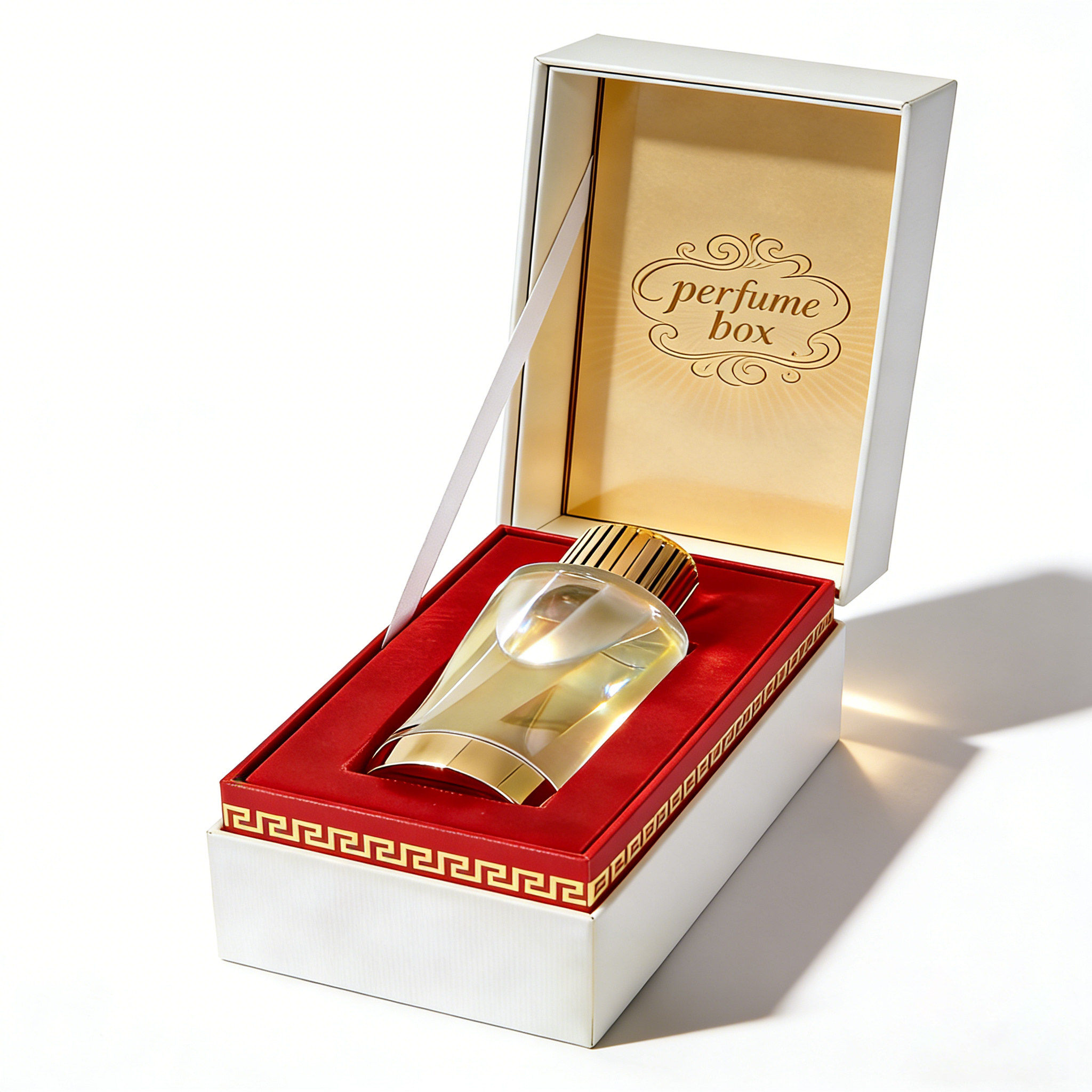
This walk-through follows a single production run at Shenzhen CKT Print Co., Ltd. for a 100 ml men's fragrance: a deep charcoal black, two-piece lid-and-base rigid setup box, wrapped in 120 g crosshatch textured specialty paper over a 2.0 mm greyboard core, finished matte, with a square offset-printed label area and a custom black velvet EVA insert. The finished outer dimension is approximately 120 x 80 x 120 mm. Every section below records the material grade, the process step, and the tolerance we hold the box to.
1. Materials: Greyboard Core and Crosshatch Textured Wrapper
The structural body of a rigid setup box does not come from a folding carton blank. It is built from a thick greyboard that is cut, grooved, and then wrapped with a printed and finished specialty paper. Choosing the two layers correctly decides whether the box opens and closes cleanly after years on the shelf.
1.1 The greyboard core
The inner skeleton uses 2.0 mm dense recycled greyboard, cut to a tolerance of +/-0.2 mm on the CNC die-cutting line. At 2.0 mm the board is stiff enough to hold a 100 ml glass bottle upright without bowing under stacking, but thin enough that the lid slides onto the base without an obvious step at the joint.
<!--[if !supportLists]-->· <!--[endif]-->Board grade: 2.0 mm solid greyboard, caliper verified per batch.
<!--[if !supportLists]-->· <!--[endif]-->Moisture content held between 8% and 10% in the pre-gluing store.
<!--[if !supportLists]-->· <!--[endif]-->Cutting tolerance: +/-0.2 mm on length, width, and diagonal.
1.2 The crosshatch textured wrapper
The outer wrap is 120 g crosshatch (cross-grain) textured specialty paper. The diagonal, intersecting lines are embossed into the paper at the mill, not printed on top. We run the wrap with the crosshatch direction matched to the longer axis of the box on every run; reversing the grain by even 90 degrees visibly changes how the corners fold and how the light moves across the surface.
Crosshatch paper is forgiving to the eye but unforgiving to the wrapping operator: any dust, oil mark, or stretching during hand gluing shows up as a glossy patch on a matte black surface.
2. Printing: Matte Offset Ink on a Textured Surface
Printing on a deep, textured black paper is a different job from printing on white coated stock. The label area on this box is a flat, square, flush panel on the top of the lid, printed in matte offset ink in white and a single warm grey. There is no metal nameplate, no hot foil, no embossed badge.
2.1 Dark substrate, light ink
Because the substrate is already deep charcoal (held near Pantone Black C and Cool Gray 11 C), the white label cannot be knocked up in one pass. The press lays down a semi-opaque white under-base first, then the headline and body type on the second pass. We read the result on a densitometer and compare against a printed master, holding color difference within a target of Delta E <= 1.5 across the run.
2.2 Flat-printed label vs. metal plate
Many luxury lines solve the label problem with a brass or nickel metal plate glued onto the lid. That reads premium, but it adds a separate part, a separate supplier, and a glue joint that can lift in a humid container. A flat offset-printed label area is one less SKU on the BOM, sits flush with the crosshatch surface, and does not conduct temperature against the glass bottle. Shenzhen CKT Print quotes both options; for this run the brand chose the printed panel.
<!--[if !supportLists]-->· <!--[endif]-->Process: 4-color offset press with matte soy-based inks.
<!--[if !supportLists]-->· <!--[endif]-->Registration: held within +/-0.15 mm on critical text.
<!--[if !supportLists]-->· <!--[endif]-->Spectrophotometer check on first 5 sheets and every 500 sheets during the run.

3. Surface Finish: Matte Texture Without Film or Foil
The wrap comes off the press with a matte finish and stays that way. No BOPP lamination, no UV spot, no hot foil. The decision is deliberate.
Film lamination would flatten the crosshatch under a glossy layer and turn the charcoal surface into a plastic-looking black. UV spot would create a wet highlight that fights with the diagonal texture. Hot foil would introduce a second reflectivity the brand did not ask for. The box is therefore sold on the paper itself: a dry, low-sheen hand feel, with the only gloss coming from the glass bottle sitting inside.
Matte does not mean unprotected. The paper is chosen for scuff resistance and the case is packed with individual polyester sleeves so the crosshatch does not rub against its neighbor in transit.
4. Structural Setup: Lid-and-Base with 45° Mitered Corners
This is a two-piece telescoping rigid setup box, not a tuck-end carton and not a magnetic folding box. The lid and the base are separate trays, each built from greyboard and wrapped individually.
4.1 Cutting, V-grooving, and wrapping
The greyboard is cut on a CNC cutting table, then V-grooved along the four fold lines so it bends to a sharp right angle without cracking the surface. The wrapper paper is cut 12 mm oversize on each side, glued with a slow-setting PVA, wrapped by hand under a positioning jig, and folded in the order: long side, short side, corner miter.
4.2 The 45° mitered corner
At each vertical corner the two wrapper edges meet at a 45° miter rather than overlapping. A clean miter requires that the greyboard edges meet first, then the paper overlap sits inside the joint, never on the visible outside corner. The corner macro below shows the joint: a hairline seam, no lifting, no glue squeeze-out, and the crosshatch pattern continuous across the two faces.

4.3 Lid-to-base clearance
The most common failure on a two-piece rigid box is not the corner, it is the fit. The lid must drop onto the base without wobbling, but not so tight that it binds in cold weather. On this product we hold the lid-to-base gap at 0.30 mm on each of the four sides, verified with feeler gauges at the setup stage and sampled on the line.
<!--[if !supportLists]-->· <!--[endif]-->V-groove depth: approximately 1/3 of board thickness.
<!--[if !supportLists]-->· <!--[endif]-->Lid-over-base drop: 18 mm, designed against the 100 ml bottle height.
<!--[if !supportLists]-->· <!--[endif]-->In-line gap check every 100 pcs during mass production.
5. Inner Fit: Velvet EVA Insert Precision
Inside the base sits a black velvet EVA insert, custom die-cut to the bottle profile. The bottle drops straight in, sits vertical and centered, and does not contact the greyboard wall.

5.1 Why velvet EVA
EVA is used here because it is firm enough to hold a glass bottle upright in a drop test, and soft enough not to scratch lacquer or metal caps. The velvet flocking on the top face is laminated to the EVA before die-cutting, so the flocked surface is what the customer sees when the lid opens.
5.2 Tolerance on the pocket
The pocket is cut to the bottle diameter plus 0.5 mm total clearance. Anything looser and the bottle rattles; anything tighter and the operator has to force it in, which can chip the bottle. Around the pocket, the exposed black EVA edge is held to a narrow band so the insert looks like a fitted socket rather than a foam block.
We test every tooling sample with the actual customer bottle before cutting production cavities. A 0.3 mm difference in neck diameter is enough to make the cap sit off-center.

6. Factory Capabilities and OEM/ODM Process
Shenzhen CKT Print Co., Ltd. runs the offset press, the rigid-box folding line, the die-cutting, and the QC inspection in-house at the Dongguan plant, which shortens feedback loops between printing and setup.
<!--[if !supportLists]-->· <!--[endif]-->Capacities: rigid setup boxes in the 50,000-200,000 pcs/month band on standard sizes.
<!--[if !supportLists]-->· <!--[endif]-->MOQ: 1,000 pcs per structure for a first order; lower MOQs quoted for sampling.
<!--[if !supportLists]-->· <!--[endif]-->Sampling: 7-10 working days for a pre-production sample after die-line approval.
<!--[if !supportLists]-->· <!--[endif]-->Bulk lead time: 25-35 working days after confirmation of artworks and payment.
<!--[if !supportLists]-->· <!--[endif]-->QC: AQL 2.5 on appearance, 1.5 on critical dimensions; inspected before packing.
<!--[if !supportLists]-->· <!--[endif]-->Trade terms: FOB Shenzhen, CIF destination port, and DDP door-to-door available.
For consistent batch-to-batch output, we keep the wrapper paper in a climate-controlled store once a run is approved, and we re-check the master proof against the first 50 pcs of every repeat order. Container loading is calculated by carton dimension and gross weight so that a 20'GP or 40'HQ fill rate is quoted before production starts.

Whether you are replacing an existing perfume rigid box or launching a new line, the questions that matter are the same: board thickness, wrapper paper grade, label method, corner construction, and inner-pocket tolerance. We document each of these on the technical spec sheet before cutting any steel rule.
Contact Shenzhen CKT Print Co., Ltd.
Send us your bottle dimension, artwork, and target annual quantity, and we will return a spec sheet with material grade, tolerance targets, and FOB/FOB/EXW options.
Contact: Sherry Wu
Mobile / WhatsApp: +86 15815525889
Email: info@cktprint.com
Website: www.cktprint.com
Alibaba Store: https://cktprint.en.alibaba.com/
Factory Address: 2-3F, Building 3, Zhong Xin Industry Area, No.8 Yuhu Road, Fenggang Town, Dongguan City, Guangdong, PRC.


 Your message must be between 20-3,000 characters!